Phonics vs. Sight Words: Which Approach Will Help Your Child Avoid Reading Difficulties?

As a mom who's been through the trenches of teaching reading, I know firsthand the frustrations that come with helping your child learn to read. You might have heard the debates about phonics and sight words, leaving you wondering which path is right. Should your child be sounding out every word, or memorizing a bunch of flashcards?
My own journey started when I noticed my first-grade daughter struggling with reading. Despite excelling in math, she couldn't read a simple sign outside our local store. That's when I knew something wasn't right with how reading was being taught.
As a researcher in education, I turned to the studies about teaching reading. What I found was eye-opening. The traditional methods used in many schools today might actually be holding our kids back from becoming strong, confident readers.
In this post, we're going to explore:
- Why the current approach to teaching reading in schools might be falling short
- The truth about sight words (hint: they're not as irregular as you might think)
- How understanding comprehensive phonics can transform your child's reading skills
- Practical tips you can use at home to boost your child's reading ability
So grab a cup of coffee (or your drink of preference) and get comfy. We're about to uncover what actually works for teaching your child to read.
The Current State of Reading Instruction
When I first started looking into why my daughter was having trouble reading, I was low-key shocked by what I discovered about reading instruction in many schools today. Let me break it down.
The Traditional Approach: A Mixed Bag
Many schools use a mix of methods to teach reading. They might introduce some phonics (teaching letter sounds), ask kids to memorize sight words, and encourage "guessing" words based on context or pictures. This approach is often called "balanced literacy."
Sounds good in theory, right? A little bit of everything should cover all the bases. But here's the problem: it's like trying to build a house with only half the tools you need, while ignoring the most crucial ones.
The Incomplete Phonics Problem
Remember learning about short and long vowel sounds? Maybe some basic phonograms? That's typically what schools teach as "phonics." But here's the kicker: it's only a small piece of the puzzle.
Traditional phonics instruction often introduces just a portion of the phonetic system. It's like teaching kids only half the alphabet and expecting them to read everything. No wonder so many words seem "irregular" and need to be memorized!
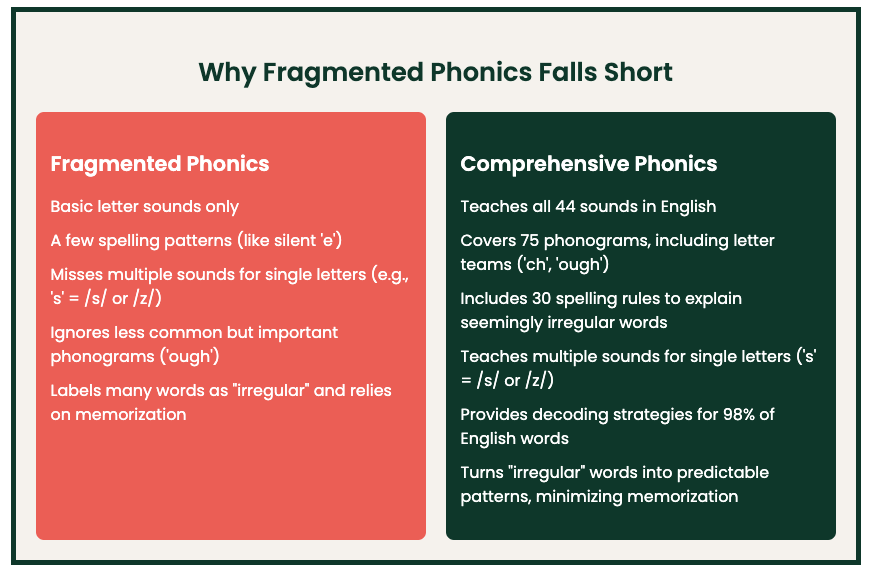
In reality, a complete phonics system includes: 44 sounds, 75 phonograms (26 letters and 49 letter teams that represent sounds), and 30 spelling rules. With this comprehensive system, kids can decode 98% of English words. Yes, you read that right — 98%!
The Overreliance on Sight Words
Because the phonics taught in schools is incomplete, many words appear not to follow the rules. The solution? Teach these as "sight words" to be memorized. Kids are often given lists of high-frequency words like "the," "said," and "was" to memorize by sight.
But there's a big problem with this approach:
- It's inefficient. Memorizing hundreds of words takes a lot of time and effort.
- It doesn't give kids the tools to read new words they encounter.
- Many of these "sight words" actually do follow phonetic rules — when you know the complete system.
The Result: Struggling Readers
The outcome of this incomplete instruction? Many kids, like my daughter, end up struggling. They might seem to read familiar texts well (because they've memorized the words), but they stumble when faced with new words or unfamiliar texts. It's like giving a kid a fish instead of teaching them how to fish.
What Is Comprehensive Phonics?
Comprehensive phonics is a complete system for decoding words that includes:
- 44 Sounds: English has 44 distinct sounds (phonemes). That's more than just the 26 letters of the alphabet.
- 75 Phonograms: Written symbols that represent sounds. For example, 'ch' is a phonogram that can make three sounds: /ch/ as in "chair," /k/ as in "chorus," and /sh/ as in "chef."
- 30 Spelling Rules: These rules explain why words are spelled the way they are and help readers predict which sound a letter or combination will make.
Kids do not need to know all these elements to start reading — in our method we encourage them to start blending sounds by the time they know just 3 letters. But the gradual build-up of the complete phonetic system (plus regular practice to make the skill automatic) is what allows kids to become expert readers.
Why Traditional Phonics Instruction Often Falls Short
Traditional phonics typically covers:
- Basic letter sounds
- Some common consonant blends like 'st' or 'bl'
- A few spelling patterns (like silent 'e')
But it often misses:
- Multiple sounds for single letters (like how 's' can sound like /s/ or /z/)
- Less common but important phonograms (like 'ough', which can make several sounds)
- Crucial spelling rules that explain seeming "exceptions"
The Power of Complete Phonics Knowledge
With comprehensive phonics:
- Kids can decode 98% of English words.
- They develop a systematic way to approach new words.
- Reading becomes a process of analysis rather than guesswork or memorization.
Studies have shown that words learned through analysis (decoding, using phonics rules) are stored in memory differently than words that are simply memorized (Yoncheva, Wise, & McCandliss, 2015). Knowing comprehensive phonics also allows kids to become self-learners: when they can decode and blend, they can read words they have never seen before without assistance.
The Truth About Sight Words
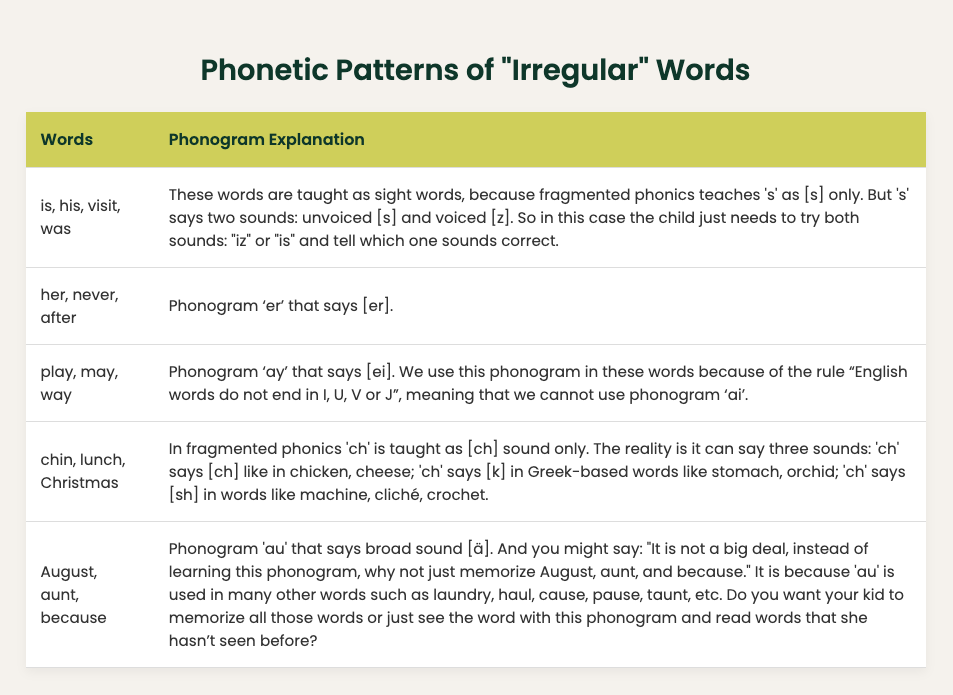
Sight words are typically defined as high-frequency words that don't follow regular phonetic patterns and thus need to be memorized — "the," "said," "was," "of," and so on. It's often said that just 300 high-frequency words make up about 65% of all written material.
Here's the kicker: most of these so-called "irregular" words actually do follow phonetic patterns. They only seem irregular because the phonics taught in many schools is incomplete.
The Problem with Memorizing Sight Words
- Inefficiency: Memorizing hundreds of words takes time better spent learning decoding skills.
- Limited Transfer: Memorizing "said" doesn't help a child read "afraid" or "maid." Teach 'th' as a phonogram with two sounds, and the child can read "both," "that," "think," and many more.
- Encourages Guessing: Kids rely on memorization and guess at unfamiliar words.
- Masks Reading Difficulties: A child can seem to read well by recognizing memorized words while lacking real decoding skills.
Rethinking High-Frequency Words
Instead of treating common words as words to be memorized, we can use them to teach phonograms and spelling rules:
- Use "the," "this," and "then" to teach the two sounds of 'th'.
- Use "to," "do," and "who" to teach the /ö/ sound of 'o'.
- Use "was" and "what" to teach the /u/ sound of 'a'.
The Science Behind Reading: How Our Brains Process Words
Our brain goes through stages as it learns to read. In the phonetic stage, the brain processes words letter by letter, converting them into sounds. Over time, as a result of constant decoding practice, most words get stored in the orthographic map of our brain, directly linked to their meaning.
But words do not get into the orthographic map by memorizing — they get there by making the decoding skill automatic through repeated exposure. Teaching pattern recognition (phonics) aligns with how our brains naturally process words.
It's like learning to type. At first you hunt and peck for each letter. With practice, your fingers seem to fly. You're still hitting each key individually; you've just become incredibly fast and efficient at it.
Practical Tips for Parents
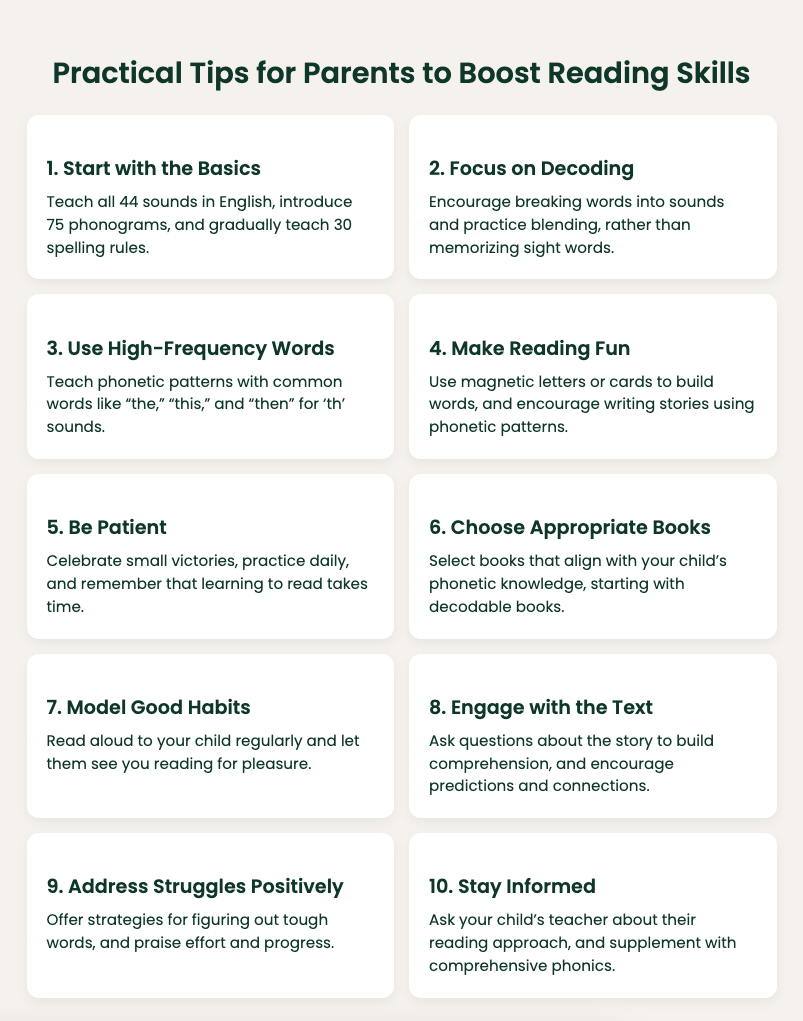
- Start with the Basics of Comprehensive Phonics. Teach all 44 sounds, 75 phonograms, and 30 spelling rules — gradually, not all at once.
- Focus on Decoding, Not Memorization. When your child meets a new word, encourage them to sound it out instead of guessing.
- Use High-Frequency Words as Teaching Tools. "The," "this," and "then" teach the two sounds of 'th'.
- Make Reading Interactive and Fun. Magnetic letters, letter cards, writing original stories with the patterns learned.
- Be Patient and Consistent. Short daily practice beats long, infrequent sessions.
- Choose Appropriate Reading Material. Decodable books that match your child's current phonetic knowledge.
- Model Good Reading Habits. Read aloud and let your child see you reading for pleasure.
- Engage with the Text. Ask questions, encourage predictions and connections.
- Address Struggles Positively. Give strategies, praise effort, not just correct answers.
- Stay Informed and Advocate for Your Child. Ask your child's teacher about their approach and supplement at home as needed.
Questions to Ask Your Child's Teacher
- What approach do you use to teach reading?
- How do you teach phonics in your classroom?
- How do you handle "sight words" or high-frequency words?
- What should I do at home to support my child's reading development?
Every child is unique, and what works for one might not work for another. Be patient, stay positive, and don't hesitate to seek additional help if needed. With the right tools and approach, every child can become a confident, skilled reader.
— Dr. Togzhan Jumagulova